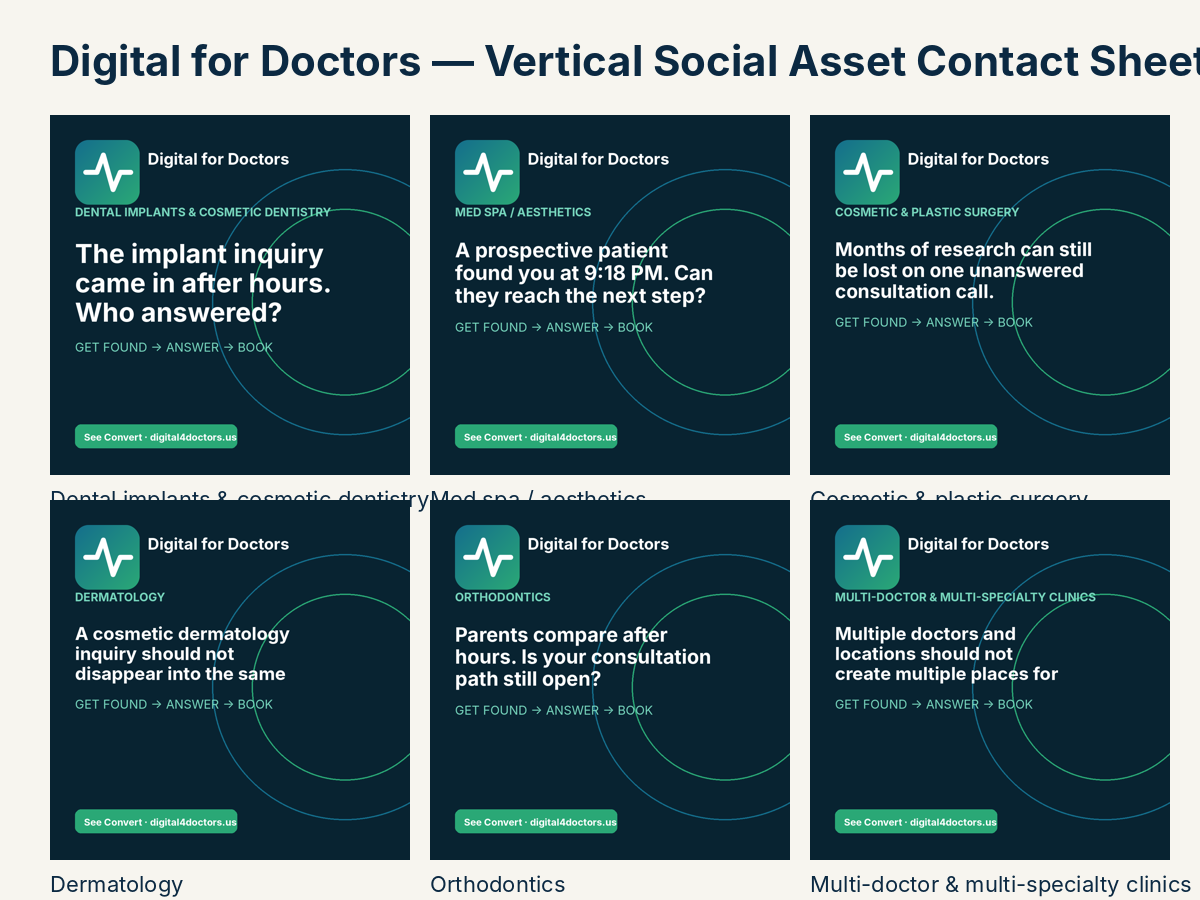
Storyline: get found for index.
Campaign landing pages mirror the specialty positioning and preserve Convert intent without attempting checkout.

The implant inquiry came in after hours. Who answered?
Open funnel →A prospective patient found you at 9:18 PM. Can they reach the next step?
Open funnel →Months of research can still be lost on one unanswered consultation call.
Open funnel →A cosmetic dermatology inquiry should not disappear into the same path as every other call.
Open funnel →Parents compare after hours. Is your consultation path still open?
Open funnel →Multiple doctors and locations should not create multiple places for an inquiry to get lost.
Open funnel →A good vertical funnel should feel like the next page in the prospect’s existing research journey, not like a generic agency page with a specialty label pasted onto it. That is why every funnel begins from a recognizable response gap inside its own market: an implant inquiry after hours, an aesthetic prospect comparing treatments at night, a plastic surgery prospect completing a long research cycle, a cosmetic dermatology inquiry that needs intent separation, an orthodontic comparison shopper, or a multi-provider organization with routing complexity.
The funnels are deliberately set to noindex, follow. Their job is campaign conversion and message match, while the main specialty pages carry the indexed organic topic. Each funnel still includes a unique title, description, canonical URL, branded Open Graph/Twitter image, structured data, and internal links so a shared URL is descriptive and the page remains part of the broader site graph.
The social brand-kit assets use the same hook, GET FOUND → ANSWER → BOOK sequence, proof-before-volume logic, and Convert offer bridge. That keeps a person from seeing one promise in a feed post, a second promise on the landing page, and a third promise when they reach the package page.
Name the specialty-specific response gap in plain language without invented urgency or revenue claims.
Explain how visibility, administrative response, approved booking, and human routing connect.
Use Convert as the default response-gap package and preserve specialty/source intent in the Contact URL.